
NEW CLICK HERE FOR AMAZON PRIME!
NEW CLICK HERE TO SEND US A GIFT! A COOL IDEA TO HELP US FOR HELPING YOU!


|



|



OHMS LAW HELP PAGES
SERIES WIRING
PARALLEL
COMBINATION SERIES PARALLEL
OHMS LAW CALCULATOR
OHM’S LAW EXPLAINED
IT'S ALL HERE!!
“The amount of current flowing in a circuit made up of pure resistances is directly proportional to the electromotive forces impressed on the circuit and inversely proportional to the total resistance of the circuit.”
Don’t let that quote scare you. It is not as scholarly as it sounds.
Before going further make sure you understand:
• What composes a circuit.
BASIC ELECTRONIC CIRCUITS EXPLAINED
In this section we will discuss what a circuit is. I won't belabor the principles of the atom -- let a physics text handle that (boring) task. Instead let's talk about the facts you will need to know to get started in electronics.
Circuit
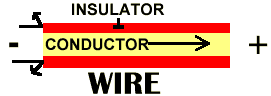
A circuit is a path for electrons to flow through. The path is from a power sources
negative terminal, through the various components and on to the positive terminal.
Think of it as a circle. The paths may split off here and there but they always form a line from the negative to positive.
NOTE: Negatively charged electrons in a conductor are attracted to the positive side of
the power source.
Conductor
A conductor is a material (usually a metal such as copper) that allows electrical current
to pass easily through. The current is made up of electrons. This is opposed to an
insulator which prevents the flow of electricity through it.
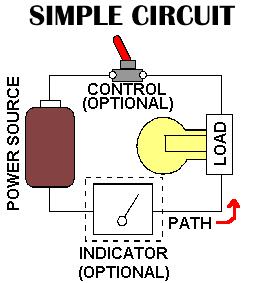 Simple Circuit Simple Circuit If we break a circuit down to it's elementary blocks we get: 1) A Power Source -- eg: battery 2) A Path -- eg: a wire 3) A Load -- eg: a lamp 4) A Control -- eg: switch (Optional) 5) An indicator -- eg: Meter (Optional) |
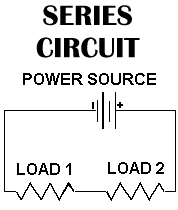 Series Circuit Series Circuit A series circuit is one with all the loads in a row. Like links in a chain. There is only ONE path for the electricity to flow. If this circuit was a string of light bulbs, and one blew out, the remaining bulbs would turn off. NOTE: The squiggly lines in the diagram are the symbol for Resistors. The parallel lines are the symbol for a battery. |
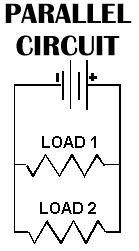 Parallel
Circuit Parallel
Circuit A parallel circuit is one that has two or more paths for the electricity to flow. In other words, the loads are parallel to each other. If the loads in this circuit were light bulbs and one blew out there is still current flowing to the others as they are still in a direct path from the negative to positive terminals of the battery. |
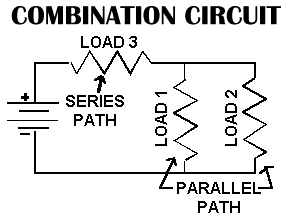 Combination Circuit Combination Circuit A combination circuit is one that has a "combination" of series and parallel paths for the electricity to flow. Its properties are a synthesis of the two. In this example, the parallel section of the circuit is like a sub-circuit and actually is part of an over-all series circuit. |
• What voltage,
current and resistance are.
VOLTAGE, CURRENT & RESISTANCE EXPLAINED
In electronics we are dealing with voltage, current and resistance in circuits.
In the next section we'll learn that by using Ohm's Law we
can determine one value by knowing the other two (For example: Figure out Current by using
Voltage and Resistance values). So it is important to firmly grasp the basics of
Voltage/Current/Resistance first.
We will describe these electrical terms using an analogy that closely resembles
electronics — HYDRAULICS.
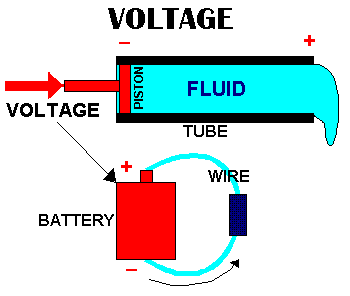 Voltage Voltage Voltage is the electrical force, or "pressure", that causes current to flow in a circuit. It is measured in VOLTS (V or E). Take a look at the diagram. Voltage would be the force that is pushing the water (electrons) forward. |
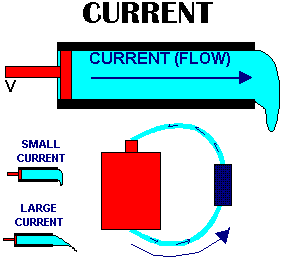 Current Current Current is the movement of electrical charge - the flow of electrons through the electronic circuit. Current is measured in AMPERES (AMPS, A or I). Current would be the flow of water moving through the tube (wire). |
| Resistance Resistance is anything that causes an opposition to the flow of electricity in a circuit. It is used to control the amount of voltage and/or amperage in a circuit. Everything in the circuit causes a resistance (even wire). It is measured in OHMS (W). A few people mentioned the diagram for this section was misleading so I am changing it. Be available soon. |
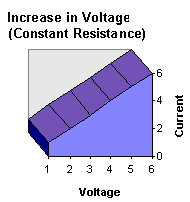
| In simpler terms, Ohm’s Law means: 1) A steady increase in voltage, in a circuit with constant resistance, produces a constant linear rise in current. |
 |
| 2) A steady increase in resistance, in a circuit with constant voltage, produces a progressively (not a straight-line if graphed) weaker current. |  |
Ohm’s Law is a set of
formulas used in electronics to calculate an unknown amount of current, voltage or
resistance. It was named after the German physicist George Simon Ohm. Born 1787.
Died 1854.
Knowledge of this Law is often under-estimated by beginners. I have talked to people that can design complex circuitry and microprocessor systems that have said, “Ohm’s Law? What’s that?”.
Unless you know this basic fundamental building block of electronics, you will never have a strong foundation to hold up the electronics towers you will be constructing in the future. Learn Ohm’s Law. Learn it inside and out!
Ohm's Law is a formulation of the
relationship of voltage, current, and resistance, expressed as: 
Where:
V is the Voltage measured in volts
I is the Current measured in amperes
R is the resistance measured in Ohms
Therefore:
Volts = Amps times Resistance
Ohms Law is used to calculate a missing value in a circuit.
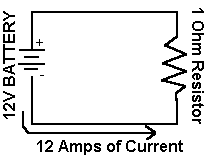 In this simple circuit there is a current of 12 amps (12A) and a
resistive load of 1 Ohm (1W).
Using the first formula from above we determine the Voltage: V = 12 x 1 : V = 12 Volts (12V)
In this simple circuit there is a current of 12 amps (12A) and a
resistive load of 1 Ohm (1W).
Using the first formula from above we determine the Voltage: V = 12 x 1 : V = 12 Volts (12V)
If we knew the battery was supplying 12 volt of pressure (voltage), and there was a resistive load of 1 Ohm placed in series, the current would be: I = 12 / 1 : I = 12 Amps (12A)
If we knew the battery was supplying 12V
and the current being generated was 12A, then the Resistance would be: R = 12/12 : R = 1W
Be sure to check out the Ohm's
Calculator to help you determine circuit values.
| Note: Remember a battery is not measured in amperage as is commonly believed with beginners to electronics. The battery supplies the pressure that creates the flow (current) in a given circuit. The amperage rating on a battery is "How long the battery will last for one hour while driving a circuit of that amperage". It is measured in Amperage-Hours. So a 1000mAh would last for 1 hour in a one amp circuit. (1000mAh is 1A for one hour) |
An easy way to remember the formulas is by using this diagram.
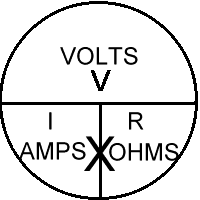
To determine a missing value, cover it with your finger. The horizontal line in the middle means to divide the two remaining values. The "X" in the bottom section of the circle means to multiply the remaining values.
• If you are calculating voltage, cover it and you have I X R left (V= I times R).
• If you are calculating amperage, cover it, and you
have V divided by R left (I=V/R).
• If you are calculating resistance, cover it, and you
have V divide by I left (R=V/I).
Note: The letter E is
sometimes used instead of V for voltage.
Or just use the quickie script below!!
Ohms Law Calculator